
“There is no such thing as an educational technology. Teachers need to creatively repurpose existing technologies for pedagogical purposes to teach content”
-Punya Mishra
Punya Mishra and Matt Koehler, of Michigan State University, created the video Break out of the Box: TPACK radio/video show to help listeners understand what TPACK really means. Any technology we use in the classroom, whether it is a physical object like a ruler or a technology such as an iPad, we shouldn’t simply teach the use of this technology exclusively. I wouldn’t have a lesson simply on rulers… what they are and how to use them. I would relate it to mathematical content. I may explain why they are useful, what we use them for, and how to use them; but, to make this technology effective for students’ learning, we would ideally incorporate them into a Math lesson.
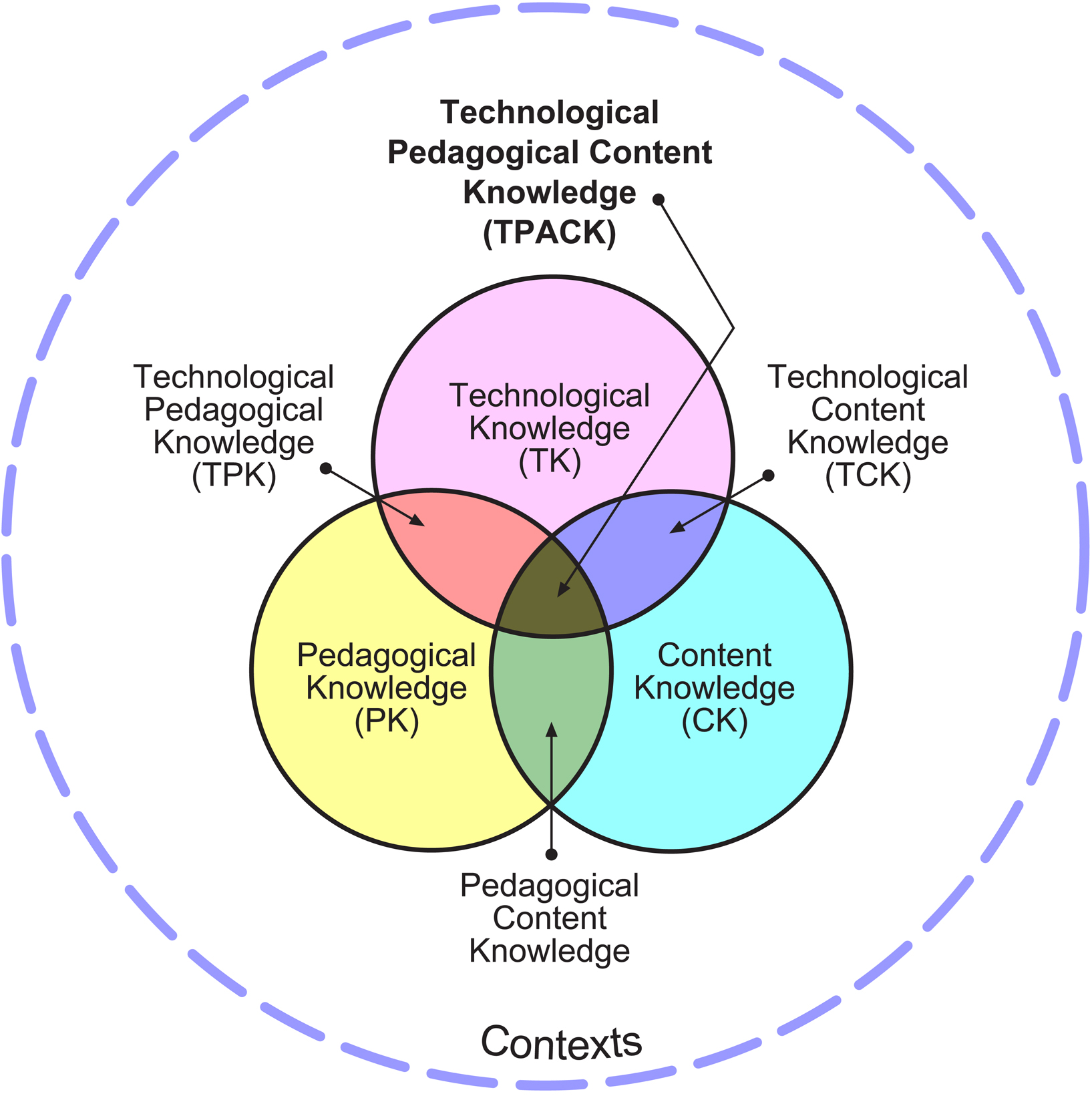
The chart above provides a visual to help one think about TPACK. TPACK results in the case of overlap between content, pedagogy, and technology. These scholars stress the importance of using technology to move beyond simply using and integrating it into lessons, but encouraging innovation with these technological tools. This will help students thrive in the ever-changing world that is full of new and upcoming technology.
Some questions that I have for this framework as a future teacher would be the following:
- Is there ever a time and place to teach the usage and ethics that come along with a technology (even if it is not related to content standards)?
- What are some useful strategies that one could use to effectively integrate the three parts of TPACK?
- How can we encourage innovation in lesson plans with technology?
- How does one make a technology one used in an educational setting?
Gee, another scholar, proposed the idea of optimal human learning, an idea of learning through experience. When we have meaningful experiences, we are able to retain that knowledge, connect to prior knowledge, and notice patterns. We often look to those with more experience to help us navigate our own and to decipher patterns and their meanings. Gee says we are “social” in our learning because of this.
One way that we can learn socially is to “talk in interaction.” By this Gee means that we experience conversations with teachers or peers and in this learn how to use language in a similar way. We essentially learn through the observations and help from others. In the world of technology, there are “affinity spaces” on the internet or social web that can be a place where people share experiences. As teachers, it is our job to use technology in a way that allows this “optimal human learning” in which we share experiences and connect and learn through one another.
The Bible says that we are all made in God’s image, which is why we need to provide students with resources that will help them live to the best of their abilities. I think that teachers have the responsibility to use technology to connect their students and let them share and learn from one another. This can be done through the TPACK framework, where technology is woven into the teaching and content. If we are able to effectively provide students with resources and skills to use technology to further their learning and connections with others. God calls us to live in community with one another. Technology is a way we can do this–we just are tasked with giving students the tools and knowledge to use it well.

TPACK: Technological Pedagogical Content Knowledge Framework
https://drive.google.com/file/d/1tKgVuFSJS0FQotYI1SXGYIIQatp7Rvrk/view
 Teaching with Technology- EDUC W80